The low-arousal knowledge engine
Bedtime stories for minds that won't switch off.
Fascinating truths, read so softly you fall asleep mid-sentence. Nothing to follow, nothing to remember.

Free to download. iPhone, dark by design.
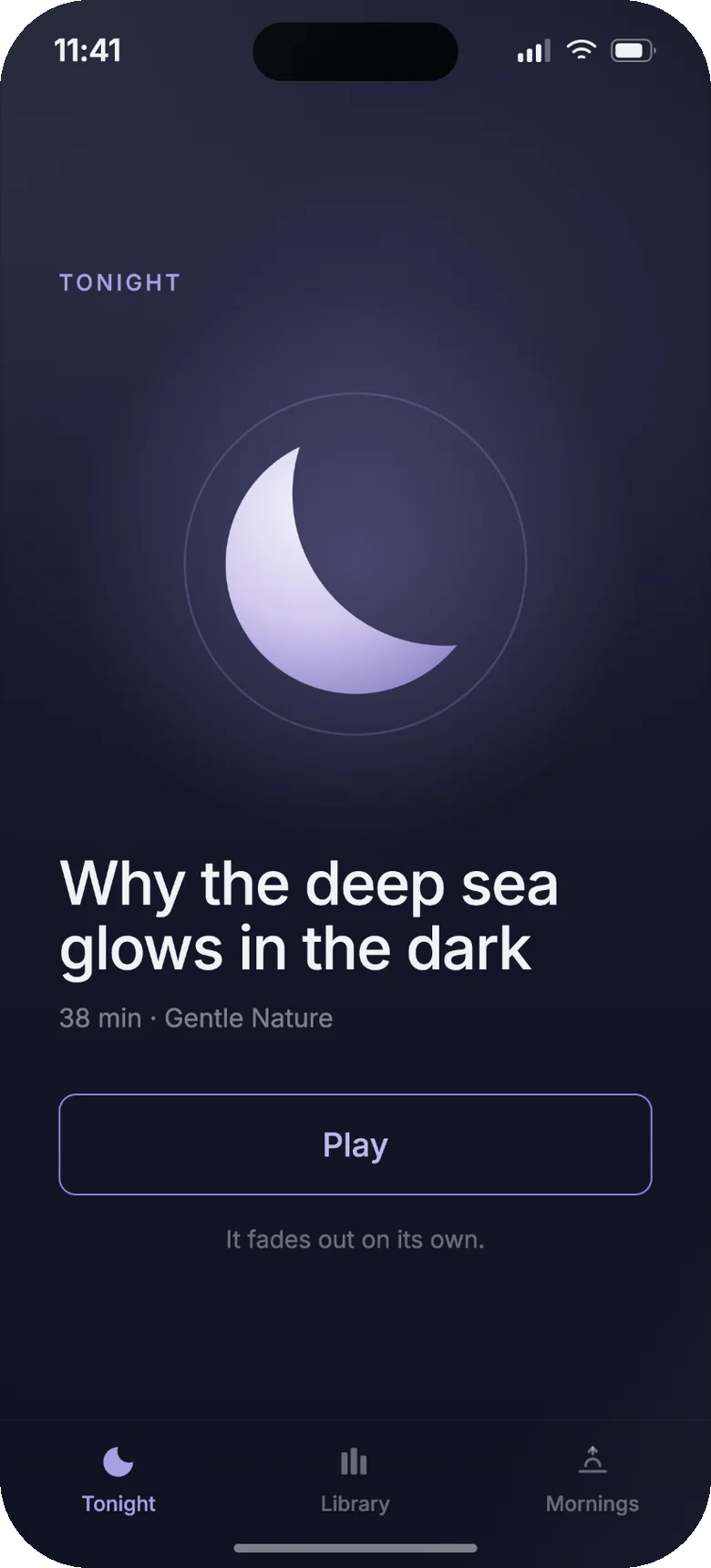
Tonight — the screen you open first.
Fades to silenceA timer at 15, 30, 45 or 60 minutes. The last ten seconds ramp down.
Keeps playing, lockedBackground and lock-screen playback. Put the phone face down.
Picks up where you driftedTomorrow starts a minute before you lost the thread.
A morning receiptThe last line you heard, and how long you stayed awake for it.
For overthinkers
Your brain isn't broken — it's just curious.
It doesn't need emptying. An unoccupied mind goes looking for work, and at midnight the only work available is tomorrow. So we give it something peaceful to ponder — with the ending given away in the first line, so there is never a reason to stay awake for it.
A night with Lullable
Four screens, and then you're gone.
Every screen below is the app itself. Nothing here is a mock-up of something we intend to build.
01
Something quietly fascinating, already chosen.
One story, picked for you, on the first screen you see. No feed, no decision to make with a phone six inches from your face. Press play and put it down.
“38 min · Gentle Nature. It fades out on its own.”
02
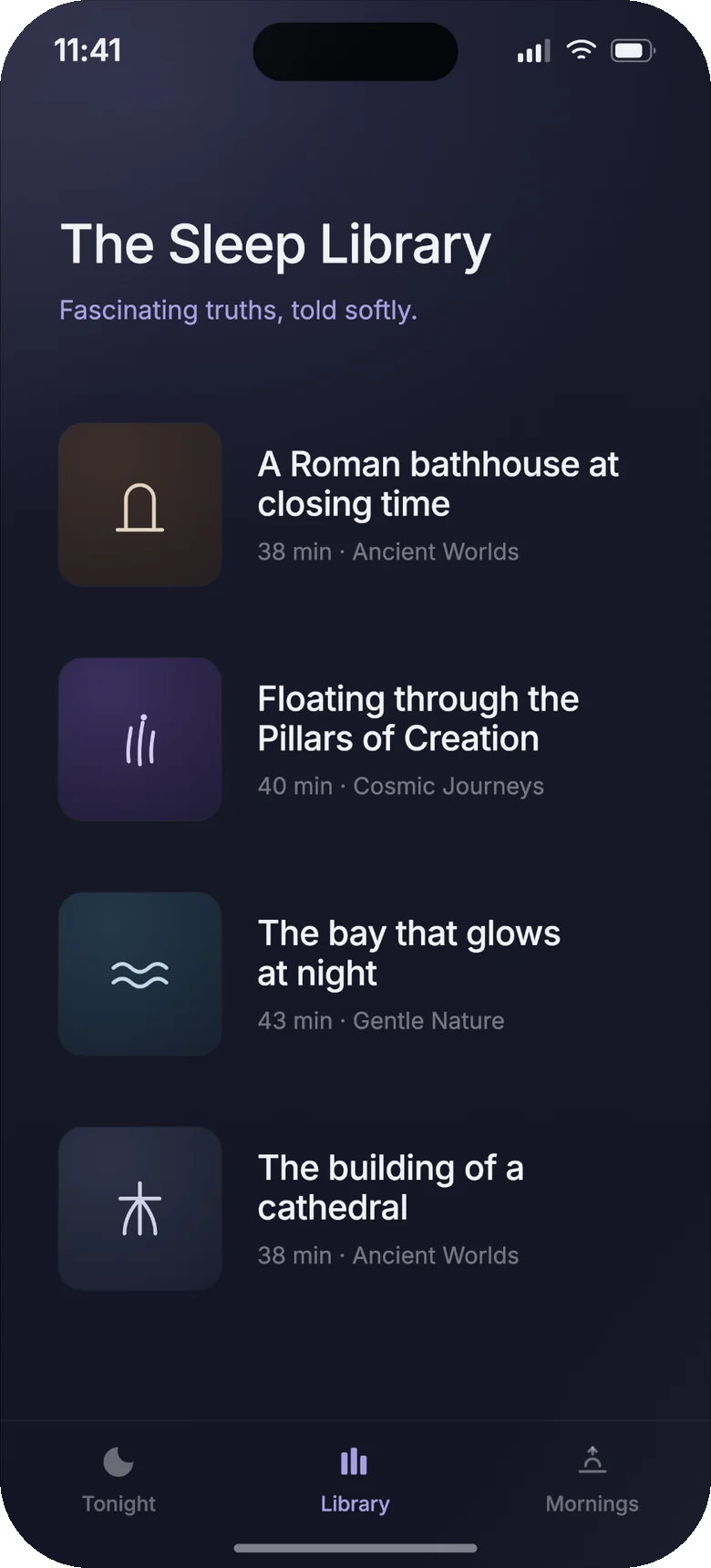
Or go and find your own.
Ancient Worlds, Cosmic Journeys, Gentle Nature, Cozy Tales. Every one a true thing explained gently and at length — a Roman bathhouse at closing time, a bay that glows, the building of a cathedral.
“Fascinating truths, told softly.”
03
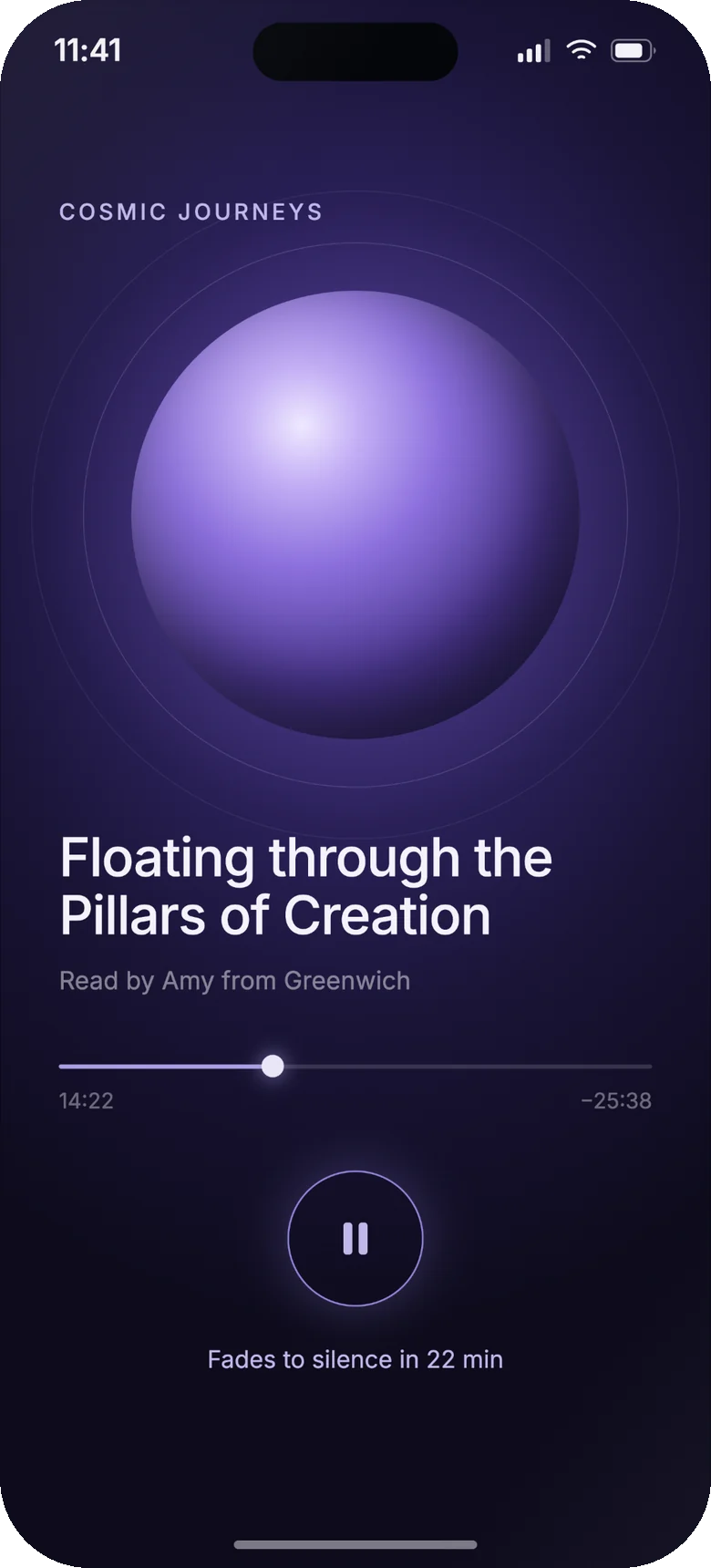
Then the app gets out of the way.
One artwork, one line of transport, a timer counting down to silence. When it ends, the last ten seconds fade rather than stop. Every recording ends the way we hope you will.
“Fades to silence in 22 min.”
04
In the morning, a receipt.
Where you left off, and the last thing you heard. Not a sleep score — it only knows the minute the audio stopped mattering to you. Funnier, and more useful, than a graph.
“Not one red dwarf has ever run down. The universe is far too young.”
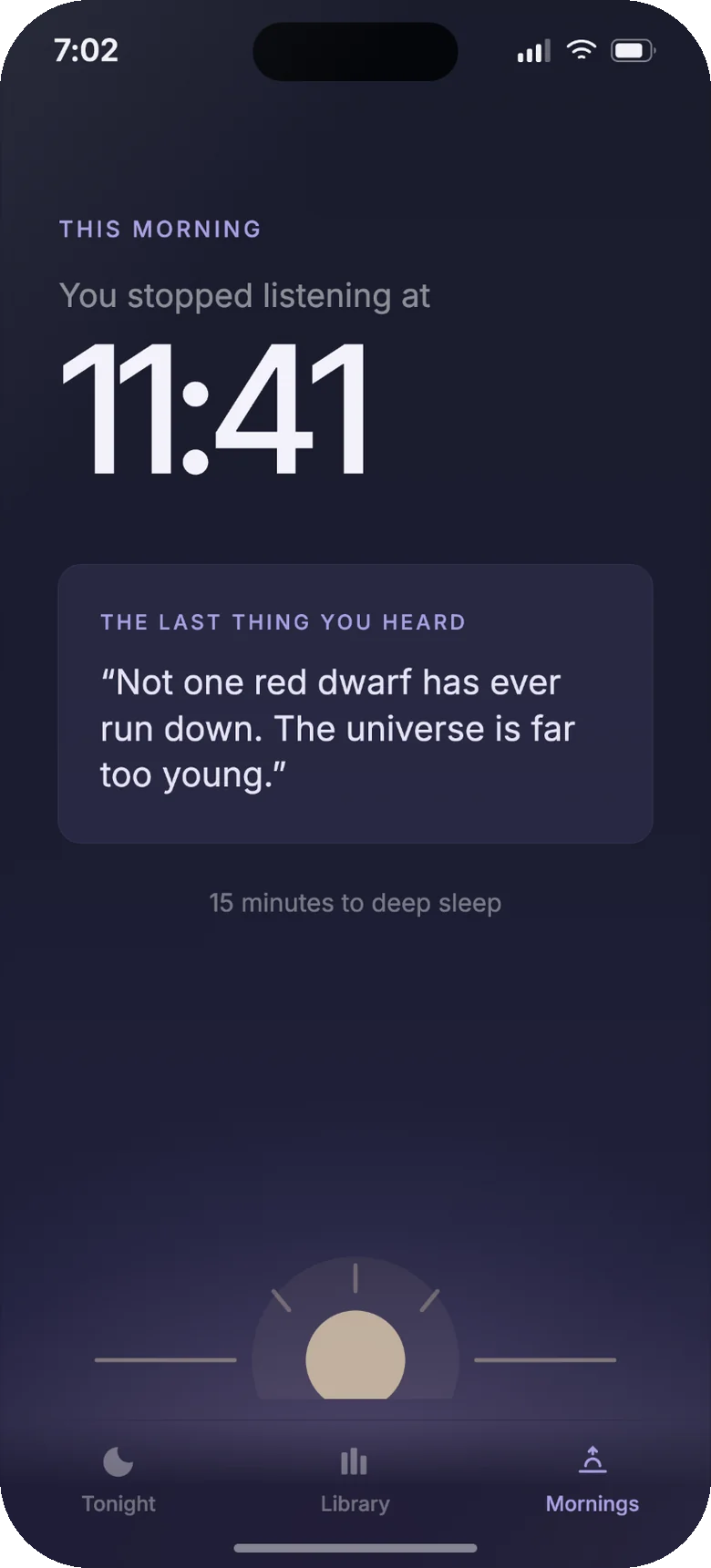
That's the whole app. Four screens, and then you're asleep.
Get the app
Free to download. Aristotle is free to listen to.
Echo Contours
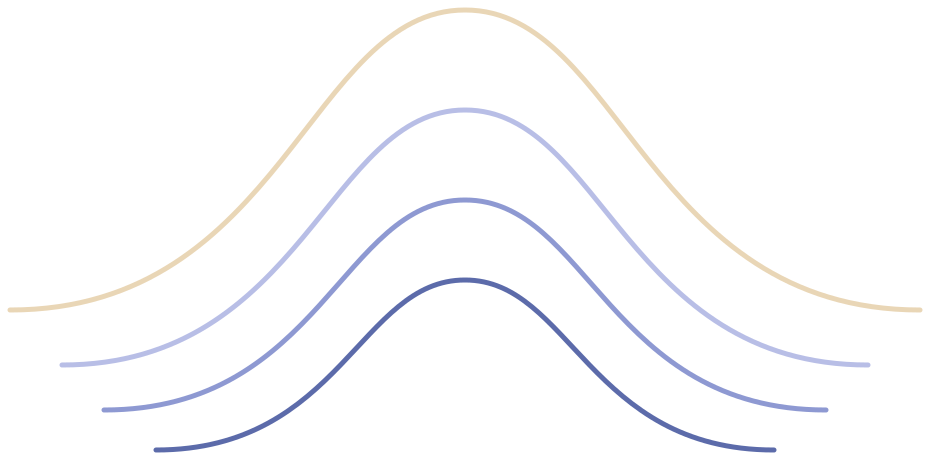
Every story gets a drawing of its own voice, trailing off.
Three to five strokes, each thinner and darker than the last, repeating in one direction. The only artwork a story ever gets: no photographs, no stock, nothing generated.
The Rings of Saturn
The Bakery Before Dawn
The Deep Ocean Trenches
Ancient WorldsCosmic JourneysGentle NatureCozy Tales
Four minutes
Listen before you believe us.
The opening of Aristotle, the Greatest Philosopher — 33 minutes in the app, four of them here. No account, no card.
0:003:54
Press play, and settle. It fades out on its own, so there is nothing to switch off.
The research
Occupying a mind is not the same as emptying one.
Poor sleepers' minds at bedtime run planning and problem-solving; good sleepers drift through loose, neutral imagery. That difference is the whole design brief. A story interesting enough to hold attention and flat enough to release it moves you from the first state to the second — then keeps going without you.
- Racing thoughts delay sleep onset; the kind of thought predicts it better than the amount. Lemyre et al., Sleep Medicine Reviews, 2020
- Serially imagining unrelated, emotionally flat things lowered pre-sleep arousal and sleep effort in randomised work on the “cognitive shuffle.” Beaudoin, Simon Fraser University
- Ten to twenty minutes to fall asleep is the healthy range. Falling asleep instantly usually signals sleep debt, not success. Ohayon et al., Sleep Health, 2017
This is the research on the mechanism, not on Lullable. No sleep app can honestly claim clinical proof of itself, and ours does not. Judge the evidence yourself; then judge the recording with your own ears.
Where it sits
Too empty, too interesting, and the narrow band between them.
Too empty
White noise
Nothing to hold. Your mind wanders back to work within a minute.
Too demanding
Meditation
“Empty your mind” is homework, and you are already bad at homework at midnight.
Just enough
Lullable
It occupies your mind until it lets go. The ending is given away in the first line.
Too interesting
Podcasts
Built to keep you listening. You stay up for the ending, and it works.
Nothing to think aboutSomething to think aboutToo much to think about
Mornings
A quiet receipt for the time you made to listen.
Where you left off, and the last thing you heard. That's all it knows and all it claims — not a sleep score, not a stage graph, not a number to improve on.
Last listen
You left off while listening to Aristotle, the Greatest Philosopher.
“A gentle walk through ideas about a good life, without needing to hold onto every detail.”
Last listened at 11:41 pm · 23 min of ancient worldslullable
The only share button in the world that means I slept well.
Get the app
It's on the App Store.
Free to download, with one story free to listen to. And if you want the letter as well — “Boringly Brilliant”, three quiet paragraphs of history or physics, Sunday night — leave an address below.
- One letter a week. Never two.
- Never a notification after 9 pm. Ever.
- Unsubscribe in one click, and we won't ask why.
- We will never sell, rent or “partner” your address.